
by Kevin McCormick February 2024
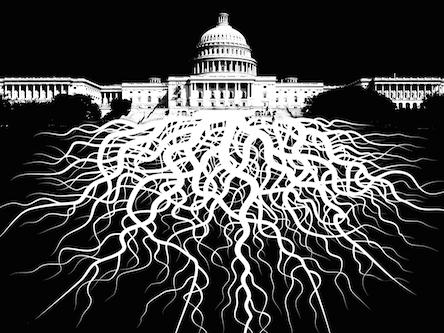
All I need to know I learned in kindergarten. But an essential question remains unanswered: which came first, the chicken or the egg? Did the Federal Reserve create a system of imperialist rapacious consumption or did a system of imperialist rapacious consumption create the Federal Reserve?
Whichever came first, we have both.
In my view, so much of the discussion on social inequity and global warming identifies the harmful symptoms of our monetary system while failing to trace these symptoms back to their origin — the banking cartel and its control of money. A recent article by Gus Speth, titled Clearing skies: Opening a new path on climate and the future (also at Resilience) actually comes near to making this vital connection.
The article points out that adaptation — preparing for droughts, floods, heat waves, and sea-level rise — are not themselves a sufficient response to climate change.
Adapting to climate change does not address the societal systems and values that spawned the current crisis. What’s needed is “systemic adaptation” that fundamentally changes our economy, our politics, and our priorities in ways that put community and the planet first.
These quotes give the flavor of four fundamental reasons for the climate crisis identified by the author:
corporate-consumerist capitalism — In today’s economy, output, productivity, profits, the stock market, and consumption must all go up. … There is no deduction for climate change’s vast social and environmental costs. … Corporations have long been identified as our principal economic actors; they and their well-to-do spawn are now also our principal political actors. … There are other sociopathic features of today’s capitalism, … but the system of money and finance deserves special note.
the U.S. security state — A 2019 Brown University analysis concluded that the U.S. military was the largest institutional source of greenhouse gas emissions in the world.
a weak, flawed democratic system — The U.S. political system is corrupted by money, focused on the short time horizons of election cycles and guided by a discouraging level of public discourse on important issues like climate change.
dominant cultural values and habits of thought — Consumerism and materialism seek to meet human needs, even non-material ones, through ever-increasing purchase of goods and services. The habit of focusing on the present and discounting the future leads away from a thoughtful appraisal of long-term consequences, …
The historical origins of the Federal Reserve might trace the hand-off of empire from the Bank of England to the Federal Reserve in preparation for World War I. Perceptive observers will note the striking similarities of the two systems — the “money supply” is the sum of bank deposits created by bank loans, a bank managed payment system tracking nearly all monetary transactions through bank account transfers, government debt supporting speculative financial markets, and an aristocratic financial elite.
In the introduction to her paper How To Spend a Trillion Dollars: Our Monetary Hardwiring, Why It Matters, and What We Should Do About It, Christine Desan makes the point:
Directing the flow of value in everyday conditions as well as emergencies, the monetary hardwiring affects the ends in profound ways. … That circuitry defines the parameters within which decisions about ends are made. In fact, it has constricted our imaginations for decades — even as it determines patterns of growth and inequality. A particular kind of hardwiring characterizes capitalism. That system amounts to the governing (constitutive) determination that the public medium of the economy — money — should be created by banks, predominantly banks operating for private profit. The determination is strange, indeed sui generis, because governments can make money without any financial intermediary or involvement. Despite its anomalous nature, the banked design for creating the money supply has gone viral in the last three centuries. During that time, it has determined the way both private and public spending happens. (emphasis added)
Social control through a banking cartel monetary system is a centuries-long condition of our culture. It gives rise to all four of the fundamental reasons for the climate crisis identified in the Clearing Skies article. The political privilege of creating legal-tender money through loans is the basis of banking cartel power and influence, the basis of corporate power, the modern basis of empire, the basis of consumerism, and the sustainer of short-term thinking. It is the political privilege to create money that allows the banking cartel to determine who receives money and on what terms. Consumer loans are given for real estate mortgages, auto loans, credit cards, and student debt — all subject to strict legal controls over borrowers. Corporations which pollute and destroy the environment are financed by the banking cartel. Naturally, the banking cartel will issue money to its political supporters and allies — the corporations and oligarchs — and it will insure the recipients compliance with the contractual terms of loan agreements and the denial of further credit as punishment for non-compliance.
As well as political control, examination of corporate ownership shows the banking cartel has the means to use economic control to advance its agenda. After years of the Federal Reserve trying to increase consumer price inflation, Wall Street funded food corporations have inflated food prices. With little notice, the banking cartel finances corporate control over agriculture. Automobile companies have dramatically inflated prices. Credit card debt has also seen a huge increase. Wall Street investors, with financing provided by the banking cartel and the Federal Reserve, have driven up home prices. Short-term thinking is encouraged and rewarded by the banking cartel. “A common practice is for loan officers to ignore the long-term risk of loans and approve those loan transactions with the highest fees and interest paid immediately — income which can be distributed to the principal executives of the bank.” Reed Simpson, banker (2006) see This Week in Money, November 30
While the banking cartel may be described as sociopathic, it actually follows the logic of protecting and exploiting its political privilege to create money. The Clearing Skies author notes: “Corporations … are now also our principal political actors.” Corporations funded by the banking cartel control the media and direct public discourse. The political control is so vital to the banking cartel position that, as Christine Desan further states: “There are no work-arounds in the current system. Public spending occurs in ways that underscore the banking logic, confirm its operation, and enlarge its ambit.”
As we experience the deterioration of our environment and society we should trace these distressing trends to their underlying systemic cause: banking cartel control over the monetary system. It should be a priority of every person and organization who cares about the environment and social betterment to recognize the necessity of taking the privilege of money creation and issuance away from the banking cartel and restoring it to the public. As Herman Daly stated: “The idea is not to nationalize banks, but to nationalize money, which is a natural public utility in the first place.”
We should not submit to a status of volunteers for the public good struggling against a well-paid mercenary army of corporate agents for the banking cartel. We change that situation by challenging the banking cartel and denying them the privilege of money creation — taking and using that privilege (actually a sovereign prerogative) with public money for the public good. In this way we gain the ability to reward and sustain progress towards systemic adaptation to the warming climate within a humane society.