
by Kevin McCormick July 2024
People who understand the climate and ecological crisis realize that transformative change of the economy is necessary. One very necessary transformation is from a growth-oriented economic system to an ecologically sustainable system. We are familiar with the observation that infinite growth on a finite planet is impossible. Despite this simple and obvious truth, the political establishment continues to strive for what is called “economic growth.” The establishment — political, media, corporate, etc. — does not operate in the context of nature, rather it operates in the context of the political and economic hierarchy, which is centered around the banking cartel and its control of the monetary system. The Federal Reserve Monetary System enables a small elite to amass enormous wealth, but this system also creates ever increasing debt for the vast majority of the population.
The vital element of the Federal Reserve Monetary system is the political privilege of banks to create debt and deposits (with deposits treated as legal tender). Commercial bank loans are created and funded by account entries — the loan as a bank asset, the deposit as a bank liability. The money creation privilege is such that commercial banks have strong incentives to create new loans, but few penalties for excessive or misdirected lending. Profits accrue to the bankers, while harms are externalized and fall on the public or the environment. There are, as well, strong incentives for borrowers to borrow additional funds — such as to obtain money to make payments on existing debt. The consumer debt that banks create often is for consumption of necessities, housing, or depreciating automobiles, and does not increase the borrower’s ability to make payments. The inescapable result is monetary inflation – new debt – becomes a source of money for payments on existing debt — the monetary growth imperative. The increase of federal government debt and the distributive spending of government payments is a source of private deposit funds that is vital to borrower credit-worthiness and is the subject of a previous article.
This system requires that borrowers can actually make consistent payments for loan interest and principal. The newly created loan and deposit amounts do not include the interest that is required to be paid by the borrower, so there is an immediate mismatch in obligations. For example, the total of payments on a home mortgage may be as much as three times the purchase price — in other words, the interest cost could be double the loan amount. When a borrower receives a bank loan, the loan proceeds (the deposit balance) are distributed to other economic participants. The borrower no longer possesses the money to entirely repay the loan, but is required to make installment payments and the borrower must have income to pay debt service as well as necessities.
If credit money is removed in any way from the flows available for debt payments, then some debt payments cannot be made unless credit money (new debt and deposits) is increased. The accumulation of large cash hoards by corporations, of vast fortunes by the elite, and of savings by ordinary people, all effectively remove money from the debt repayment flows. New credit creation is needed to provide the funds for debt payments and is a significant cause of monetary inflation and the exponential growth of debt. These considerations are discussed in Monetary Adaptation to Planetary Emergency: addressing the monetary growth imperative, where the point is made that “… if the debtors in aggregate are not able to earn enough money to service their debt (over and above securing their livelihood), then aggregate debt must increase.”
Policy tools would somehow be needed not just to control the aggregate amount of spending, but to ensure the sales volume of every debtor was within parameters that enabled their debt to be serviced but did not encourage them to borrow more. It is hardly imaginable that this kind of macro- and micro- economic management could take place in a capitalist economy. Therefore, in a capitalist debt-money economy, the ‘withdrawal from circulation’ mechanism will structurally generate spending shortfalls, thus locking in future growth: this is the MGI (monetary growth imperative). (page 16)
While the policy tools imagined above are designed to exactly balance debts and payment ability, a real-life example of “policy tools” used to manage credit money is provided by the Desenrola Brasil, a credit management program, which, as the article notes, “… seems to be a functional strategy that supports mass consumption via indebtedness for the purposes of rentier accumulation.” As Brazil pursues fiscal austerity, limiting government debt and spending, the Desenrola Brazil policy creates “… a nation where debt rollover is part of the struggle for survival …”
After a decade of expanding consumer debt in Brazil, the default rate on consumer debts rose as high as 44%. The M2 money supply for Brazil, created by bank credit, has increased by about 18% per year from 2020 to 2024, from 3.04 billion to 5.33 billion. This monetary inflation is necessitated by the indebtedness of the Brazilian consumer and supports the conclusion from Monetary Adaptation to Planetary Emergency that when debtors cannot obtain enough money to make debt payments, then aggregate debt must increase.
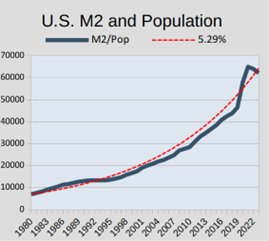
Experience in the United States also demonstrates the monetary growth imperative. The graph shows the U.S. M2 money supply divided by the population for each year from 1980 to 2023. The M2 money supply per person has increased by approximately 5.29% annually. The population has increased by approximately 0.9% annually. The population in 1980 was 229 million, and the M2 money supply was 1.6 trillion, or about $7,000 per person. In 2023, the population was 336 million and M2 was 20.8 trillion — about $62,000 per person — 8.2 times higher than in 1980. Despite such a huge increase in money, no one would argue that the average American was 8.2 times better off in 2023 than in 1980. Over this time span the U.S. middle income share of aggregate income has declined from 60% to 42%, indicating that inflation of the money supply has been distributed very unequally across the population. The debt oppression and monetary inflation experience in the United States is perhaps less dramatic than the experience in Brazil, but the facts of inadequate income, increased consumer debt, and increased financial accumulation by the elite in both countries show there is indeed a monetary growth imperative in debt-money financial systems.
The debt-money system of the banking cartel, the Federal Reserve Monetary System, creates a self-reinforcing system of debt expansion which is often described as “economic growth,” but which is more accurately described as the monetary growth imperative. The debt-money system operates without constraints from “externalities” and cannot be adapted to the requirements of an ecologically sustainable economy — not in Brazil, not in the United States, and not anywhere else — as is made clear in Escaping Growth Dependency, a publication of the monetary reform advocacy group Positive Money, .
The Green Party platform Greening the Dollar proposal, which provides the solution to the present dysfunctional monetary arrangement, has three essential parts:
- Require Congress to be the sole creator of all U.S. money debt-free;
- End the privilege of commercial banks to create money.
- Transfer all operations of the Federal Reserve to the U.S. Treasury.
Unlike the Federal Reserve System, a sovereign money system does not create a monetary growth imperative. With a democratic government, creation of money by the government is constrained by the public opposition to inflation and will also be constrained by the reduction of debt and elimination of the monetary growth imperative. The NEED Act (HR-2990) contains a plan for the transition to a sovereign monetary system which does not rely on debt creation and provides an escape from the monetary growth imperative. Replacing the Federal Reserve Monetary System with a system such as provided in the NEED Act will allow the government to be a positive force in addressing the environmental crisis and the social crisis brought on by excessive debt. Adopting a sovereign monetary system where money creation and issuance does not create debt, such as provided in the NEED Act, is an essential part of the transformative change we need.
Reference citations:
Arnsperger, Christian, Bendell, Jem ORCID: https://orcid.org/0000-0003-0765-4413 and Slater, Matthew (2021) Monetary adaptation to planetary emergency: addressing the monetary growth imperative. Institute for Leadership and Sustainability (IFLAS) Occasional Papers Volume 8. University of Cumbria, Ambleside, UK.. (Unpublished) Downloaded from: insight.cumbria.ac.uk/id/eprint/5993 ]
Board of Governors of the Federal Reserve System (US), M2 [M2NS], retrieved from FRED, Federal Reserve Bank of St. Louis; fred.stlouisfed.org/series/M2NS , March 27, 2024.
U.S. Bureau of Economic Analysis, Population [POPTHM], retrieved from FRED, Federal Reserve Bank of St. Louis; fred.stlouisfed.org/series/POPTHM, March 29, 2024.