

Rural Investment Proposal
Texas needs significant investment in the rural agricultural economy. Many urban dwellers may not realize that agriculture is a foundation pillar of the Texas economy. Yes, our food comes from the grocery store, but it is grown and prepared on farms and in a large processing and distribution network. A healthy agricultural sector will add to the diversity, resilience, and stability of the Texas economy. It is also very important to public health that our food and water be safe and of high quality, and agriculture has a major effect on water availability and quality.
Farmers and ranchers need more and better information about land management strategies and methods to protect water resources and increase water availability and quality. We know about permaculture strategies — water catchment berms, specific planting patterns, and growing perennials and food producing trees, for example. We also know about practices of regenerative agriculture — focus on soil microbiology, keeping land covered, rotational grazing, new methods of fertilization, and crop rotation plans. These are appealing ideas and they show great promise. They also require investment in the resources to support these innovations and improvements.
The USDA has announced a “Regenerative Pilot Program” to help American farmers adopt regenerative agriculture. Texas needs to do the same. We need to provide the necessary resources to help Texas agriculture transform into a sustainable, soil building, water conserving, and toxic chemical free foundation of our economy. I believe the State of Texas can help farmers with a research assistance program in which farmers singly or in cooperation with other farmers, agronomists, or researchers, conduct documented experiments with regenerative agriculture practices. The participants would design the experiment and document the process and the expenses. The farmers would submit their documentation to the Agriculture Department and be reimbursed for their expenses. The farmers would report their results and discuss problems and successes. The documentation would be published as public domain literature. It is vitally important that farmers and ranchers have the knowledge and confidence that regenerative agriculture practices will work for them and their operations.
Texas also needs agricultural resilience. We need the jobs and economic activity that locally produced healthy food will create. We cannot rely on global trade to assure our food supply. Global trade is subject to geopolitical events and is vulnerable to financial crisis. There is no way to assure Texans that imported foods are not contaminated by toxic pesticides, herbicides, preservatives, and processing chemicals. This is why I will include a major program to establish family farm greenhouse production of vegetables in my rural investment program.
Greenhouse Proposal
My greenhouse proposal is a program of grants and low interest loans to fund greenhouse operations for family farmers and sole-proprietor growers — no corporations. The goal is for each grower to produce enough to feed twenty people. Greenhouses would be limited to 10,000 square feet in total for any one grower. The land for the greenhouses could be owned or leased. Growers would be encouraged to form cooperatives so as to be able to reliably offer a variety of vegetables throughout the year. Cooperatives could also include field grown produce so long as the grower is eligible for the program. Participating grocery stores would pay the retail price for vegetables to the growers and grocery stores would receive a remittance of 5% of their purchases from the state. The use of synthetic chemicals would be strongly discouraged and organic practices strongly encouraged. There would be an ongoing, open-source, research and educational program to develop and improve methods and practices. I believe this program would enable thousands of people to make a living doing something they love and significantly improve food quality for all Texans.
Hemp Crop Proposal
I believe the hemp crop is important for soil conservation, crop rotation, and production of food and fiber. Hemp fiber is a basic input to many production and manufacturing processes. The hemp crop can be a valuable addition to the farmer repertoire. I also believe the hemp crop is a necessary addition to Texas agriculture as we try to adapt to global warming. This is because of the superior carbon sequestration and soil building characteristics of hemp.
I believe the most important things the State of Texas can do for hemp farmers is to invest in processing facilities and adopt a “parity pricing” program to assure farmers a return and to stabilize the hemp market. The parity pricing program would objectively evaluate the production costs of a standardized hemp crop and provide the farmer with an option to sell their crop to the state for the parity production cost. The farmer could cancel the option at any time and sell to the market or the state would take delivery and later sell to the market.
Rural Infrastructure
I will also seek to increase the "County Road and Bridge Fund," perhaps by dedicating one cent of the twenty cent state fuel tax to this fund. This fund is used by the County Comissioners Court to fund maintenance of rural roads, which often need improvement. I will include an authorization for County Commissioners to also use these funds to construct bicycle paths, no less than four feet wide, joining rural towns, villages, and points of public use.
We live in the environment
I keep in mind these words from former ExxonMobil CEO, Rex Tillerson:
And as human beings as a — as a — as a species, that’s why we’re all still here. We have spent our entire existence adapting, OK? So we will adapt to this. Changes to weather patterns that move crop production areas around — we’ll adapt to that. It’s an engineering problem, and it has engineering solutions. And so I don’t — the fear factor that people want to throw out there to say we just have to stop this, I do not accept.
Texas has a global warming problem
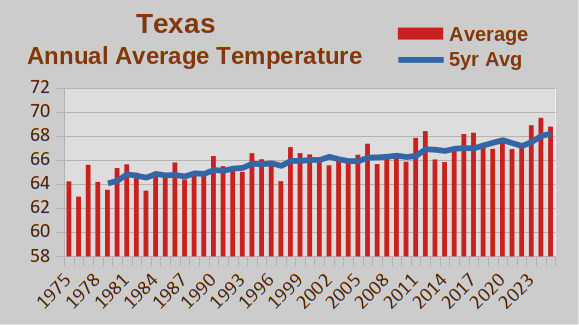
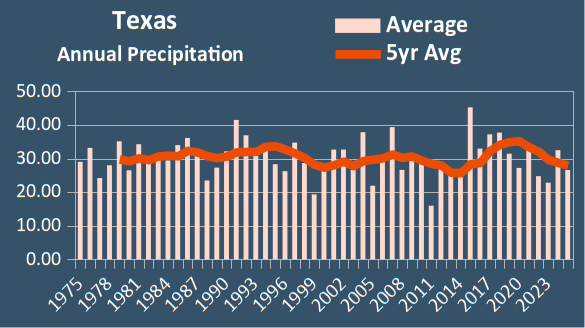
Since 1975 the Texas annual average temperature has risen over 4 degrees Fahrenheit (about 2.3 degrees Celsius). Texas annual precipitation has also declined by about 2 inches per year. Rising temperature and declining rainfall mean that Texas is drying out. Water availability and quality will become an ever-present issue, creating conflict over water resources. The trend is clear. We can expect temperatures to continue rising and Texas, especially the western half, to become more hot and dry. (graph derived with data from NOAA. (download spreadsheet)) The water crisis in the Rio Grande Basin demonstrates that the global warming crisis is upon us and decisive, effective action is required.
[U]rban and agricultural water conservation programs have thus far been unable to produce the reductions in water consumption required to stabilize—much less restore—the water sources within the RGB (Rio Grande Basin). Overconsumption Gravely Threatens Water Security in the Binational Rio Grande-Bravo basin
If the establishment parties want to address these problems, they have to get started. But the Republican and Democrat parties represent the banking cartel and Wall Street corporations. Their first priority is to protect corporate profits. Adapting to global warming is simply not profitable for Wall Street.
How then are we going to adapt to global warming? What are the solutions? I could state the obvious — transition to renewable energy and regenerative agriculture — and run headlong into the financial and corporate establishment. To answer these questions, we must instead rely on the people of Texas. Global warming is far more than an engineering problem — it is a social problem, a knowledge problem, an agriculture problem, a transportation problem, a financial problem, and a survival of society problem. Rather than pursuing a grand systemic transformation, I believe it will bring greater progress if we enable the public to incorporate solutions into daily life. We must seek out successful strategies and pursue these strategies with resources that are adequate and appropriate. These solutions must be made available to the public and they must be practical. We also should understand that it is a step-wise process of gradual adoption, which is evaluated and refined by experience throughout the process.
The rural investment program I propose would help to create a more resilient and sustainable agricultural sector and make progress in adapting to global warming while improving the quality of food and water in Texas.
The more votes for Kevin McCormick for Lieutenant Governor in the 2026 election, the more likely it becomes that the Texas Legislature will take positive actions to advance resilient and sustainable agriculture for Texans.