
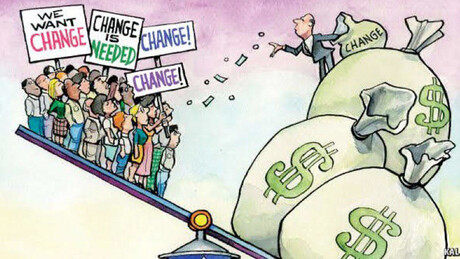
The Green Party of the United States platform calls for a fundamental shift in the economic landscape by advocating for monetary reform. The party's Banking and Monetary Reform Committee highlights the potential benefits of this approach to address economic inequities through more equitable taxation and the creation of public wealth.
There are three fundamental requirements of effective monetary reform: 1) require Congress to be the sole creator of all U.S. money as an asset, not a debt; 2) end the privilege of commercial banks to create what we use as money; and 3) transfer the operations of the Federal Reserve to the U.S. Treasury.
We must focus on how money is created and issued as well as on how money is spent. For our democracy to thrive, the public must have meaningful influence over all three facets of the monetary system.
This change in thinking will help to shift the monetary debate to a focus on fair and equitable issuance of money. Is it fair and equitable that a tiny Wall Street elite (the banking cartel) create and issue money based upon their opportunity for profit from debt? Is it fair and equitable that fluctuations in the credit cycle can bring the entire economy to its knees and distribute hardship throughout the population? Of course not—the status quo is neither fair nor equitable. The Federal Reserve System places the political power to create and issue money in the commercial banks, a group that is dominated by a few huge banks which presently are also in the process of absorbing smaller banks. Money should be created and issued by a Congress that is responsive to public needs and serves the public interest, with monetary institutions designed to serve the public.
We have just witnessed a debate over the federal debt. While the U.S. Constitution grants Congress the power to coin money, we are instead forced to borrow money created by the banking cartel, This comes with the realization of a huge and growing interest expense and military-industrial complex costs coupled with inflation and reduced social and economic welfare for the public, Instead, Greens would re-frame the debate this way: Should Congress increase or decrease the money supply; and is an imperial military really more necessary than social programs and environmental protections?
Furthermore, the Green Party emphasizes the importance of shifting the focus from exclusive private wealth creation to the creation of public wealth. By investing in public infrastructure, social programs, and sustainable development, the Green Party aims to ensure that economic prosperity benefits all citizens, not just a privileged few.
The quality of our future depends on creating a sustainable society that functions in harmony with the natural world. We must have a monetary system that is appropriate for the future. Such a monetary system cannot be based upon debt. The Federal Reserve System depends on debt and interest payments. It is a system that must devour ever increasing amounts of resources and the environment to feed the exponential demands of interest and usury. The Green Party platform advocates a monetary system that does not rely on debt, that is democratic and responsive to public needs, and which supports a sustainable and just society.
The Green Party's Banking and Monetary Reform Committee invites citizens to explore their platform and learn more about the proposed reforms by visiting their official website at greensformonetaryreform.org. Additional information on the party's stance on economic justice and sustainability can be found at gp.org/economic_justice_and_sustainability#monetary-reform, while specific articles for monetary reform are available at gp.org/greenbacks_not_bailouts. To combat corruption and promote transparency, visit gp.org/combat_corruption_and_promote_transparency.