
by Kevin McCormick January 2024
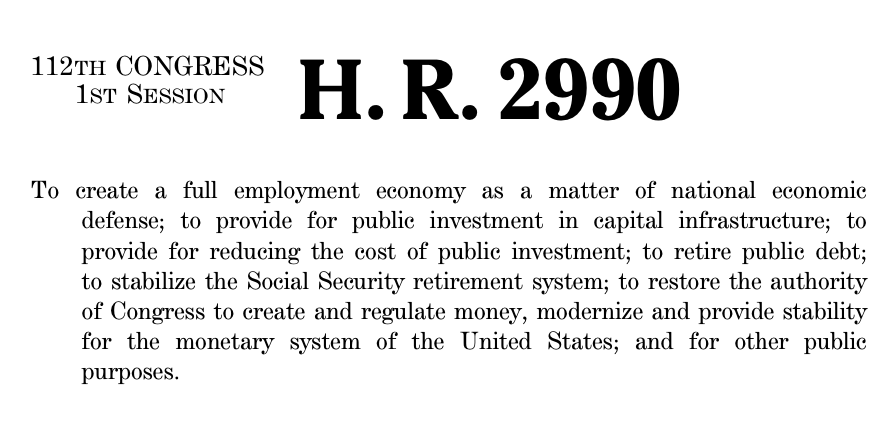
The NEED Act provides the outline of a monetary system that serves a sustainable and humane society. History shows us that a sustainable society requires a public money system designed to serve public purposes, in contrast to the present federal reserve monetary system which is based on bank-created debt and deposits and serves the political agenda and profit motive of the banking cartel. Control over the creation and issuance of money is the heart of banking cartel and corporate power. The NEED Act takes this money power from the banking cartel and places it in the government, under the Congress as provided in the U. S. Constitution. Despite the exploitative nature of the federal reserve system, available credit is necessary to the functioning of society. The NEED Act includes a system for supplying credit which is based on the concept of a revolving fund.
A revolving fund is a money balance from which money is borrowed and then returned so that it can be borrowed again. Individuals use a revolving fund concept with their credit card available credit, although the interest rates are exorbitant. The revolving fund concept is used by the Community Development Revolving Loan Fund of the National Credit Union Association
The NEED Act provides that, as bank loans are repaid, the banks will transfer those payments to the newly created revolving fund. Instead of debt payments being an accounting entry – subtracted from deposit accounts and from loan balances (which extinguishes their existence as money), the amount is transferred to the revolving fund where it will serve as part of the credit supply.
SEC. 403. ESTABLISHMENT OF FEDERAL REVOLVING FUND.
(a) REVOLVING LOAN FUND.—Subject to provision in advance in an appropriation Act, there is hereby established a revolving loan fund in the Treasury of the United States where amounts received from depository institutions under terms specified in section 402 of this Act shall be deposited and made available for relending to banking institutions and for other purposes.
Banks would be able to lend their own money without relying on the revolving fund, but I expect that to be a minor source of credit. The design of the revolving fund implies that the amount of available credit in the future will be roughly equal to the amount of existing credit at the time the NEED Act goes into effect. Also implied is that the amount of available credit will stay the same over time. When a bank wishes to make loan, the bank would receive the money that is to be lent from the revolving fund. As the loan is repaid, the principal would be returned to the revolving fund, while the interest on the loan will be income for the bank.
We can anticipate several issues with this structure. The obvious and likely least important issue is government regulation of loan availability. The NEED Act continues the banking system’s role of metering out money by extending credit. Banks will continue to evaluate loans according to the creditworthiness of borrowers and will continue to lend against assets such as real estate and automobiles. Bank lending is highly regulated under the federal reserve system, so the most likely difference in regulation would be a change in the regulatory agenda — from banking cartel power and profits to economic stability and fair allocation of credit. This will be manifested in bank solvency requirements and in regulations to prevent bank creation of credit-money, for example: overdraft privileges for deposit account checks, which surreptitiously create extra credit in the payment system.
A more subtle issue will be the inflationary or deflationary effects of bank lending practices. The present federal reserve system requires constant inflation to enable payment of compounding interest. Historical data demonstrates that bank assets (loans, credit, or debt) overall increase at a compound rate of between 6% and 8% annually. With the revolving fund system, the available credit will not increase unless the fund is increased. But we can expect the revolving fund to slowly decrease over time because some loans will not be fully repaid and that amount of principal will not be returned to the revolving fund. There are too many variables to permit a prediction of the importance or outcome of this issue. However, if overall debt is reduced and members of the public become more financially secure, one can expect a variety of controversies to arise as the financiers push back against the public escaping their debt traps.
A third issue is whether the revolving fund will begin with an appropriate size. Is it necessary or desirable to maintain the present level of credit? I believe it is possible that the revolving fund would initially be too large — that there would be too much credit available. If real estate and consumer price inflation are reduced to levels near zero, then the present amount of credit could easily exceed the necessary amounts for the future. If the revolving fund is initially too large and banks seek to lend all available credit, it is possible for unsound loans to be made resulting in losses and instability in the banking system.
Contrary to statements that a government-issued public money would be inflationary, my belief is that the NEED Act system would be somewhat deflationary. The NEED Act places the responsibility for the monetary system squarely on Congress. Monetary instability, i.e. inflation or deflation, will be strongly opposed and members of Congress will not be able to deny responsibility. The NEED Act system will have great inertia and be quite difficult for special interests to manipulate in their favor and against the public. Additionally, inflation is truly the enemy of working families, as we see so clearly today with unaffordable housing, medical care, transportation, food, and education.
As was written by Frederic Soddy in 1934 in The Role of Money (p58):
What the public want is a constant price-index, so that the value of money remains stable in goods and services. That they cannot have, as we shall see, without destroying "banking" as now understood. Here, as always, one has to distinguish very sharply between the interests of the public and those of their real rulers; and so far democracy has never had a government that could trust itself to rule independently of the money-power.
The challenge before us is to master the monetary system — to turn this sovereign power to serve the public instead of an elite financial royalty. The NEED Act provides the outline of the most practical plan to accomplish this. The revolving fund and the credit supply it creates will be of great importance in a monetary system that serves the public.